

.avif)
.avif)
.avif)


Browse all articles
If your SaaS marketing funnel feels unpredictable, you're not alone. Most teams are running plenty of campaigns—ads, content, landing pages, nurture sequences—yet pipeline doesn't grow consistently because the funnel is leaking between stages.
That's why funnel optimization matters more than simply generating "more leads." When you optimize your SaaS customer acquisition funnel stage-by-stage, you improve SaaS conversion rates, shorten time-to-revenue, and lower customer acquisition cost (CAC)—without constantly increasing spend.
This guide walks through how to optimize a SaaS marketing funnel step-by-step, including the best SaaS funnel metrics to track, the most effective marketing funnel optimization techniques, and what to test at each stage (TOFU, MOFU, BOFU).
Step 1: Define Your SaaS Marketing Funnel (Based on How You Sell)
A SaaS marketing funnel is the path customers take from first awareness to becoming a retained user (and ideally an advocate). The problem: many teams use a generic funnel that doesn't match their GTM motion—so the data becomes noisy and optimization becomes guesswork.
Start with a Clear B2B SaaS Funnel Model
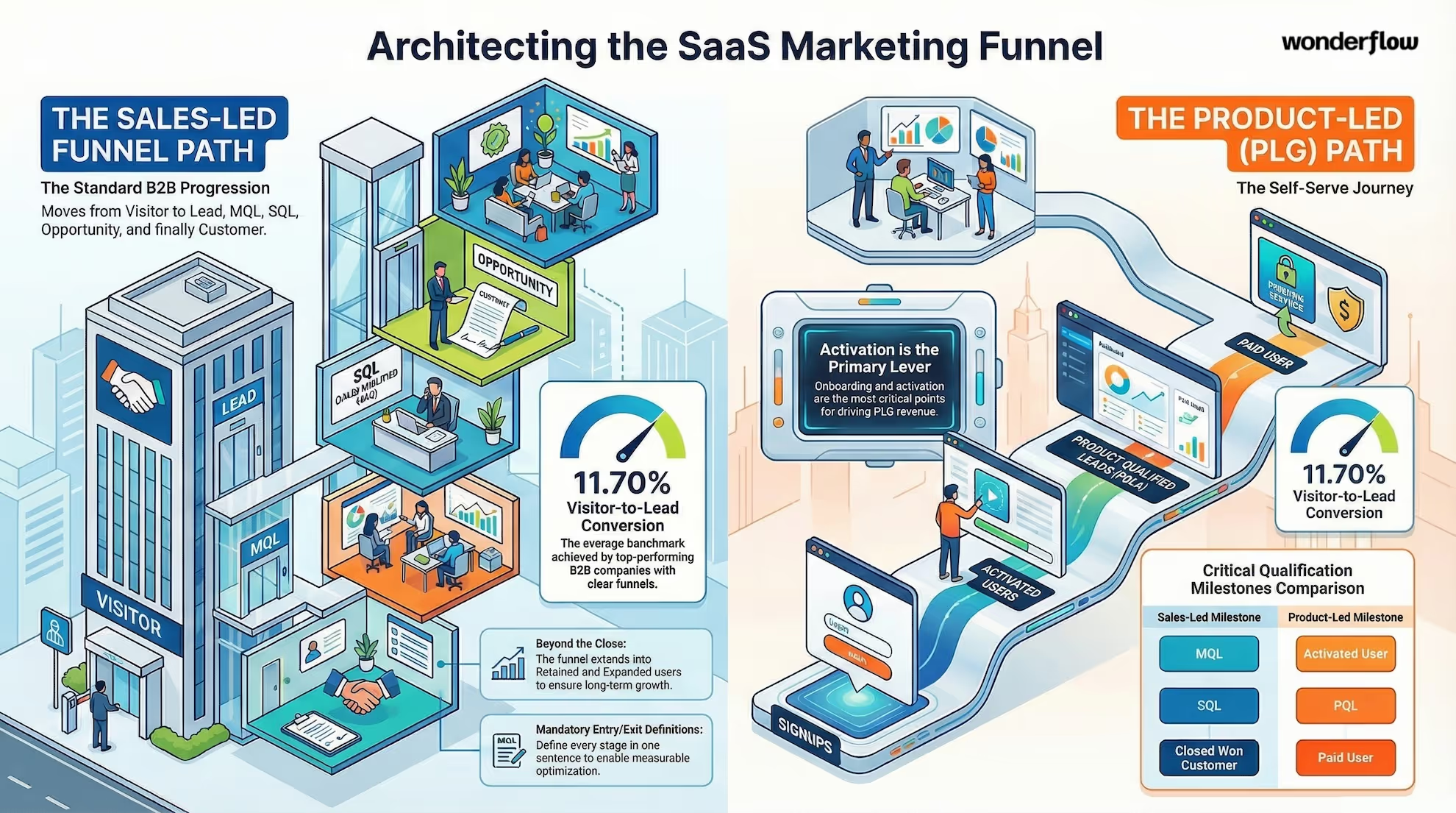
Most B2B SaaS funnel frameworks look like:
- Visitor → Lead
- Lead → Marketing Qualified Lead (MQL)
- MQL → Sales Qualified Lead (SQL)
- SQL → Opportunity
- Opportunity → Customer
- Customer → Retained / Expanded
That's a strong default for a SaaS sales funnel with a sales motion.
Adapt Funnel Stages for PLG (If Relevant)
If your product has a trial, freemium, or self-serve path, you'll often add:
- Signup → Activated User → Product Qualified Lead (PQL) → Paid
This is where free trial optimization, onboarding, and activation become your biggest levers.
Best practice: Write a one-sentence "entry/exit definition" for every stage. If you can't define what makes an MQL an MQL, you can't optimize it. According to recent B2B SaaS benchmarks, top B2B companies achieve an average conversion rate of 11.70% from visitor to lead—but only if their funnel stages are clearly defined.
Step 2: Set SMART Goals (Work Backward from Revenue)
A real marketing funnel strategy starts with outcomes—not tactics.
Instead of "get more traffic," define goals like:
- "Generate $X in pipeline per month"
- "Hit $X in new ARR by Q4"
- "Reduce CAC by 15%"
- "Increase trial-to-paid by 20%"
Then work backward using conversion rates between marketing funnel stages.
The Simple Reverse-Engineer Method
- Start with a revenue target
- Convert it into required customers (based on average deal size / plan mix)
- Work backward to opportunities, SQLs, MQLs, leads, and traffic
This turns SaaS funnel optimization into math, not vibes. Research shows that most B2B SaaS companies see a 5-10% trial-to-paid conversion rate, which means if you need 100 new customers, you'll need approximately 1,000-2,000 trial starts depending on your onboarding quality.
Step 3: Fix Tracking First (Or Funnel Optimization Won't Stick)
You can't do conversion funnel optimization if attribution is broken and stage transitions aren't reliably tracked.
At minimum, your funnel tracking should include:
- Channel + campaign tracking (UTMs, source/medium mapping)
- Lifecycle events (lead, MQL, SQL, opp, customer)
- Key actions (trial start, demo booked, activation milestones)
- Cost data tied to outcomes (to measure CAC and ROI)
- Touchpoints across the SaaS customer journey (ads, content, product, sales)
Also: accept that some of your SaaS customer journey happens in the "dark funnel"—private communities, word of mouth, Slack groups, and untrackable content consumption. Your job is to reduce blind spots, not pretend they don't exist.
Step 4: Track the Right SaaS Funnel Metrics (Conversion + Velocity + Efficiency)
This is where most teams mess up: they measure volume, but not speed or cost.
1) Conversion Metrics (The Basics)
These are your core SaaS funnel metrics to track:
- Visitor → Lead
- Lead → MQL
- MQL → SQL
- SQL → Opportunity
- Opportunity → Customer
- Trial → Paid (if PLG)
- Overall Lead → Customer rate
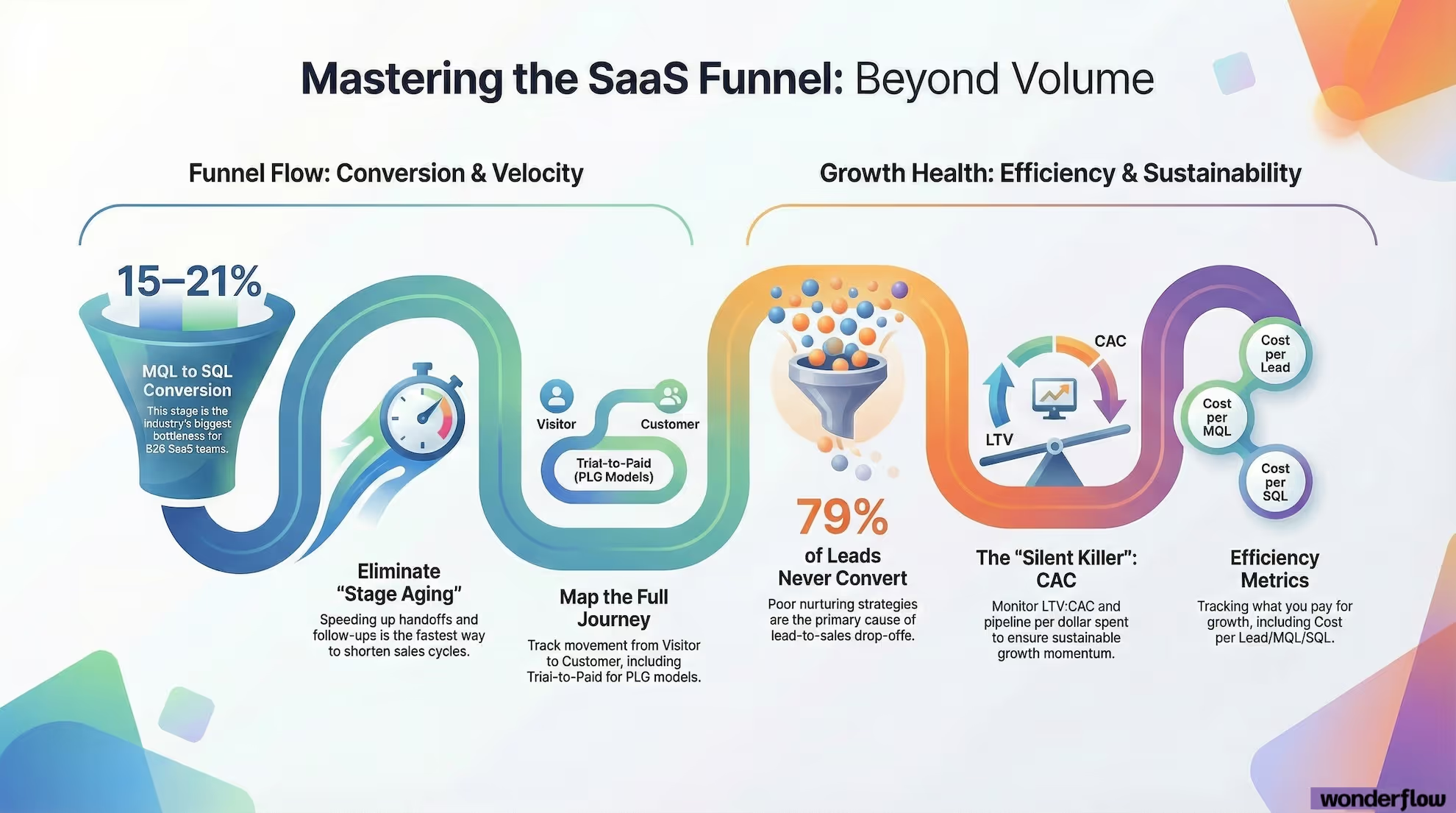
This is SaaS funnel conversion optimization in its simplest form: improve the weakest conversion rate. According to 2025 B2B SaaS benchmarks, the MQL→SQL stage is often the biggest bottleneck, with average conversion rates of just 15-21%.
2) Velocity Metrics (How Fast Revenue Moves)
Velocity tells you where the funnel slows down:
- Time to MQL
- Time to SQL
- Sales cycle length
- Stage aging (how long deals sit)
Sometimes the fastest win in funnel optimization is speeding up handoffs and follow-up.
3) Efficiency Metrics (What You Pay for Growth)
If you're not tracking these, CAC will quietly kill your momentum:
- Customer acquisition cost (CAC)
- Cost per lead / MQL / SQL
- Pipeline per $ spent
- LTV:CAC ratio (long-term health)
Industry data shows that 79% of leads don't convert into sales due to poor nurturing, which means your efficiency metrics need to include the quality of your follow-up and engagement strategies.
Step 5: Identify the Bottleneck (The Constraint That's Limiting Growth)
Here's a reliable rule: the biggest leak or slowdown is the first thing you fix.
Run this quick diagnostic:
- Where is the biggest drop-off between stages?
- Where is the biggest delay (velocity)?
- Which channel brings low-quality leads that never become MQLs/SQLs?
- Where does sales say leads "aren't qualified"?
- Where do users churn early (onboarding funnel issues)?
Pick one bottleneck. Build experiments around it. That's real marketing funnel optimization techniques—focused, measurable, repeatable.
Stage-by-Stage Funnel Optimization (TOFU → MOFU → BOFU)
This is the practical playbook: awareness stage optimization, consideration stage tactics, and decision stage conversion—plus retention.
TOFU: Awareness Stage Optimization (Get the Right People In)
In TOFU, you're not trying to "close." You're trying to earn attention and capture intent.
What Works in the Awareness Stage
- SEO + content that matches real pain points (not product fluff)
- Paid search for high-intent educational queries
- Paid social that creates demand when prospects aren't in-market
- Strong lead generation offers (templates, playbooks, webinars)
Landing page optimization tip: Don't send TOFU traffic to your homepage. Build high-converting landing pages that match the search/ad intent with one clear next step.
TOFU Metrics to Watch
- CTR, bounce rate, engaged sessions
- Visitor → lead conversion rate
- Cost per lead (by channel)
Research indicates that the average landing page conversion rate is 2.35%, but top performers achieve 5.31% or higher through rigorous testing and optimization.
MOFU: Consideration Stage Tactics (Turn Interest Into Evaluation)
MOFU is where people compare options and decide whether you're worth their time.
What Works in the Consideration Stage
- Use-case pages (specific pain → specific outcome)
- Competitor comparisons (fair + confident)
- Case studies (role/industry matched)
- Retargeting based on behavior (pricing page visits, product page depth)
- Email nurture that educates (not spams)
This is where conversion rate optimization (CRO) really starts paying off—because small conversion lifts at MOFU compound downstream.
MOFU Metrics to Watch
- Lead → MQL rate
- Return visitor rate
- Demo/trial start rate
- Content-assisted conversions
Studies show that it typically takes 6 to 8 touchpoints to move a lead through the sales funnel and generate a viable sale, making your MOFU nurture strategy critical.
BOFU: Decision Stage Conversion (Reduce Friction + Build Confidence)
BOFU is where you win or lose deals. Your job: make buying feel obvious.
What Works in the Decision Stage
- Clear pricing and packaging (who it's for, what you get, why it's worth it)
- Proof close to conversion (logos, testimonials, case studies, security FAQ)
- "Objection" pages (implementation, security, integrations, ROI)
- Fast follow-up and clean handoff between marketing and sales
- Simple forms and fewer steps
If you run a trial: this is free trial optimization territory—activation, in-product prompts, lifecycle emails, and time-to-value.
BOFU Metrics to Watch
- MQL → SQL, SQL → Opportunity, Opportunity → Customer
- Trial → Paid, PQL → Paid
- Time to close, win rate
Industry benchmarks suggest that 80% of sales require at least 5 follow-ups after the initial meeting, so persistence combined with value delivery is essential.
Retention: Onboarding Funnel, Churn Reduction, and Retention Strategies
In SaaS, conversion isn't the finish line. Retention is where profitability lives.
What Works After the Sale
- A structured onboarding funnel (guided setup, checklists, templates)
- In-app education tied to "aha moments"
- Lifecycle emails that reduce drop-off
- Customer success check-ins for higher ACV plans
- Community + customer advocacy loops
Retention ties directly to customer lifetime value (LTV)—and improving LTV gives you room to scale paid acquisition without CAC panic. Data shows that upselling to existing customers is 68% more cost-effective than acquiring new ones.
Retention Metrics to Watch
- Activation rate and time-to-value
- Early churn (first 30–90 days)
- Feature adoption
- Expansion and referrals
Step 6: Run Experiments (A/B Testing That Actually Compounds)
Optimization is not a redesign. It's a discipline.
A Simple Conversion Funnel Optimization Loop
- Choose one bottleneck
- Write a hypothesis (what change should improve what metric)
- Run a test (A/B testing, landing page optimization, lifecycle email test)
- Measure impact (conversion + velocity + CAC)
- Ship the winner, document learning, repeat
Key: Don't test random stuff. Test the step that's currently limiting growth.
Professional services firms that focus on systematic testing see compounding improvements of 15-25% in conversion rates over 6-12 months compared to teams that optimize sporadically.
SaaS Marketing Funnel Best Practices (What to Avoid)
Here are the common mistakes that stall SaaS funnel optimization:
- Tracking gaps that make the funnel data unreliable
- Stage definitions that change depending on who you ask
- Optimizing traffic volume while ignoring lead quality
- Ignoring velocity (slow funnels burn cash)
- Weak onboarding funnel (high churn cancels growth)
- Running too many experiments at once without a clear constraint
Slow page speed killing your conversions? See just how much:
Ready to Optimize Your SaaS Marketing Funnel?
If you're serious about improving your SaaS funnel optimization outcomes—conversion rates, velocity, and CAC—you need a systematic approach that connects every stage of your customer journey.
At Wonderflow, we specialize in building and optimizing complete marketing flows that turn clicks into customers. We don't just run campaigns—we create one focused customer journey at a time, connecting traffic, experience, and conversion into a single measurable system.
Here's What We Can Help You Build:
Funnel Mapping + Stage Definitions — Clear TOFU/MOFU/BOFU structure with lifecycle tracking that actually works
Tracking + Attribution Audit — So your data becomes trustworthy and actionable
High-Performance Landing Pages — Webflow sites built for speed, conversion, and continuous optimization
Paid Media + Creative Testing — Campaign architecture and ad creative designed to learn and improve
SEO + Content Strategy — Content systems that drive qualified traffic ready to convert
Marketing Automation + Lead Flow — Forms, CRM integration, and lifecycle emails that route leads instantly
Free Trial Optimization + Onboarding — In-product experiences and email flows that drive activation
Retention Strategies + Churn Reduction — Post-purchase systems that turn customers into advocates
Why Work With Wonderflow?
✅ One Flow. One Goal. We focus on a single customer journey at a time—no scattered campaigns
✅ Performance-First Creative — Every design and message is tied to intent, speed, and conversion
✅ Move Faster. Learn Smarter. We launch quickly, track the right signals, and run focused tests
✅ Unlimited Tests — Continuous optimization with 48-hour creative turnaround
✅ Cancel Anytime — No long-term contracts or retainers
Start Optimizing Your Marketing Flow
Whether you're running a sales-led motion, product-led growth, or a hybrid approach, we'll help you identify your biggest bottleneck and build a system that consistently drives pipeline.
We'll review your current funnel, identify the biggest leak or slowdown, and show you exactly what we'd optimize first.
Free 15-day flow setup · Pause anytime · No long-term commitment
View Our Pricing → | See How It Works →
Looking for more marketing performance insights? Check out our Performance Blog for actionable guides on conversion optimization, page speed, and paid media strategy.
.jpg)
.avif)
.avif)